Svält beror förstås på brist på mat, men den intressanta frågan är hur det kommer sig att det blir brist på mat (för vissa grupper) i ett land. I en recension* av Stephen Devereux, publicerad i Journal of Economic Literature, klargörs att svaret i fallet Nordkorea främst står att finna i landets ekonomiska och politiska system (s. 1038—1039):
Many famines are triggered by natural disasters, but these shocks only expose the underlying causes, which are invariably failures of national economic and political systems. The authors demonstrate through a “food balance sheet” analysis that food availability did decline in North Korea in the early 1990s, but they make the telling observation that “food availability cannot be treated as exogenous” (p. 23), especially in socialist systems, but is the product of particular government policy choices. … Haggard and Noland identify many features of socialist political economies that predispose them to famine. These include the absence of political freedoms and civil liberties, government controls on internal migration and foreign travel, systemic information failures, and “the lack of accountability characteristic of authoritarian regimes” (p. 10). It is no coincidence that the same factors were identified as contributing to China’s “Great Leap Forward” famine (see Dali L. Yang and Fubing Su 1998). Underlying all these factors is the absence of democracy and the accountability that democracy brings. The authors conclude that North Korea remains highly vulnerable to famine, and that this structural vulnerability will not be “definitively resolved until that regime is replaced by another one that, if not fully democratic, is at least more responsive to the needs of its citizenry” (p. 3).
Rent allmänt stämmer detta väl överens med den analys av Nord- och Sydkoreas ekonomiska utveckling som Daron Acemoglu m.fl. gör i bokkapitlet ”Institutions as a Fundamental Cause of Long-Run Growth” (s. 406—407):
It is possible that Kim Il Sung and Communist Party members in the North believed that communist policies would be better for the country and the economy in the late 1940s. However, by the 1980s it was clear that the communist economic policies in the North were not working. The continued efforts of the leadership to cling to these policies and to power can only be explained by those leaders wishing to look after their own interests at the expense of the population at large. Bad institutions are therefore kept in place, clearly not for the benefit of society as a whole, but for the benefit of the ruling elite, and this is a pattern we encounter in most cases of institutional failure that we discuss in detail below.
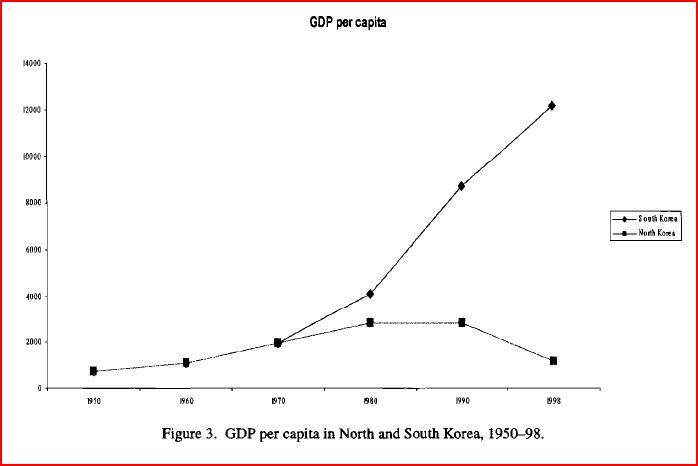
Svält som ett resultat av egoistiska styresmän som inte kan ställas till svars, alltså. De visar detta talande diagram över Nord- och Sydkoreas utveckling:
Betoningen av det ekonomisk-politiska systemets roll som en förklaring till svält har tidigare med särskild pregnans framförts av ekonomipristagaren Amartya Sen, kanske främst i boken Poverty and Famines från 1981. KVA sammanfattar:
Here, he challenges the common view that a shortage of food is the most important (sometimes the only) explanation for famine. On the basis of a careful study of a number of such catastrophes in India, Bangladesh, and Saharan countries, from the 1940s onwards, he found other explanatory factors. He argues that several observed phenomena cannot in fact be explained by a shortage of food alone, e.g. that famines have occurred even when the supply of food was not significantly lower than during previous years (without famines), or that faminestricken areas have sometimes exported food.
Så ja, svält beror på brist på mat, men en sådan brist har i sin tur ofta sin förklaring i de ekonomiska och politiska institutionerna. Vore de annorlunda skulle människor i regel inte svälta.
_________________________
*Denna bok recenseras:
Haggard, Stephan och Noland, Marcus (2007). Famine in North Korea: Markets, Aid, and Reform. New York: Columbia University Press.


 Nonicoclolasos
Du måste vara inloggad för att kunna skicka en kommentar.